1. Executive summary
CareTV is an effort to make existing home technology behave as one coherent assistive system. Televisions, cameras, microphones, computers, browsers, IP networks, remote controls, family communications and local AI should not each demand a separate cognitive model from the person using them. The core proposition is that the person states an intention and CareTV absorbs the implementation complexity.
A person might say “show the front door,” “put the news on,” “call Grandma,” “what is next today?” or “send this document by fax.” CareTV resolves that request into a semantic command, chooses an appropriate local or remote implementation, performs the action through APIs or deterministic automation, verifies the result, and provides a simple confirmation or recovery path.
The same open platform is intended to range from a free browser running on ordinary hardware to a high-end research home with GPUs, large local storage, standards-based cameras, 100GbE and 8K media. The laboratory is the research ceiling, not the consumer floor.
2. The human problem
Modern “smart” homes are frequently accessible only to people who can remember which app controls which function, maintain numerous accounts, recover from device-specific failures, understand changing interfaces and tolerate repeated live support interactions. This is a poor fit for dementia, memory impairment, sensory disability, limited mobility, cognitive overload and many forms of social or communication disability.
CareTV does not treat the answer as a toy-like reduced-function device. The harder goal is to preserve sophisticated capability while moving the complexity behind a low-burden human interface. That also reduces caregiver workload: a technology that requires another person to operate it every time is itself a recurring care task.
3. Architecture: API-first, local-first, WAN-capable
The visible interface should consume CareTV-owned APIs rather than directly hard-code every vendor or browser. Device adapters, camera protocols, Windows UI automation, telecom gateways and AI services remain replaceable behind that contract. Standards such as IP, Ethernet, RTSP, ONVIF, WebRTC and SIP are preferred whenever they satisfy the requirement.
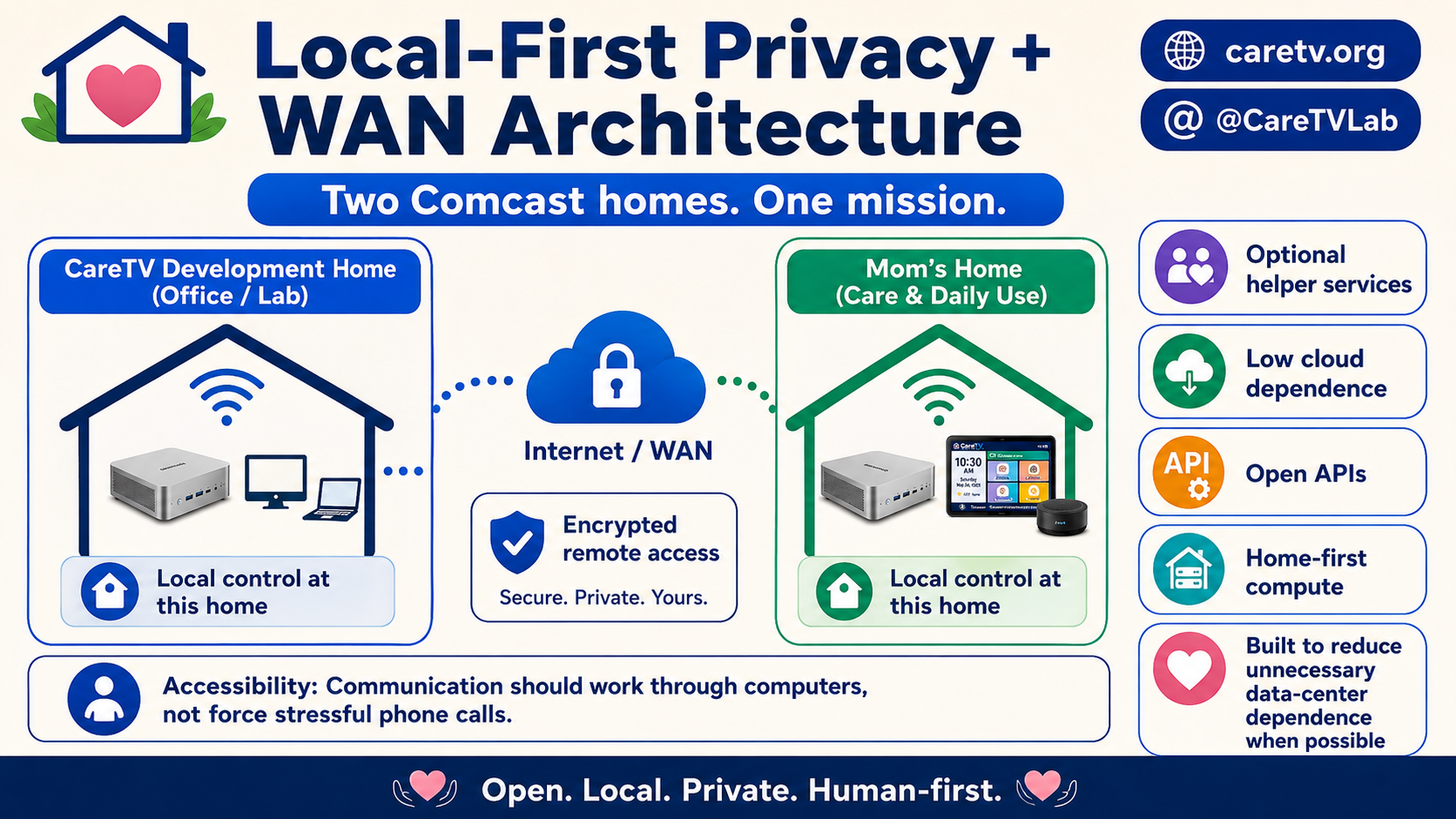
Local-first does not mean offline-only. It means local control, local storage and local inference are preferred for tasks whose inputs and outputs are already in the home, while WAN connectivity is available for trusted remote family, public hosting, difficult NAT traversal, translation, optional cloud inference and backup.
4. Human interface and deterministic execution
| Human request | Semantic action | Possible implementation |
|---|---|---|
| “Show the kitchen.” | open_camera(kitchen) | RTSP/ONVIF → grid → full screen |
| “Put Rachel on.” | watch_program(person/program) | Intent resolution → YouTube TV UI automation → visual verification |
| “Call Grandma.” | call(trusted_identity) | WebRTC first; SIP/PSTN fallback by policy |
| Big remote button | known semantic command | FLIRC/HID → local CareTV agent |
| “Send this to Comcast.” | prepare/send institutional message | Email/API where possible; browser/UI automation or fax adapter where necessary |
AI can interpret ambiguity and recover from unknown states, but routine execution should be deterministic. The desirable control loop is: intention → normalized command → known state machine/API → action → state verification → success or recovery. This is materially more reliable than allowing an AI agent to improvise mouse clicks continuously.
5. Unified communications
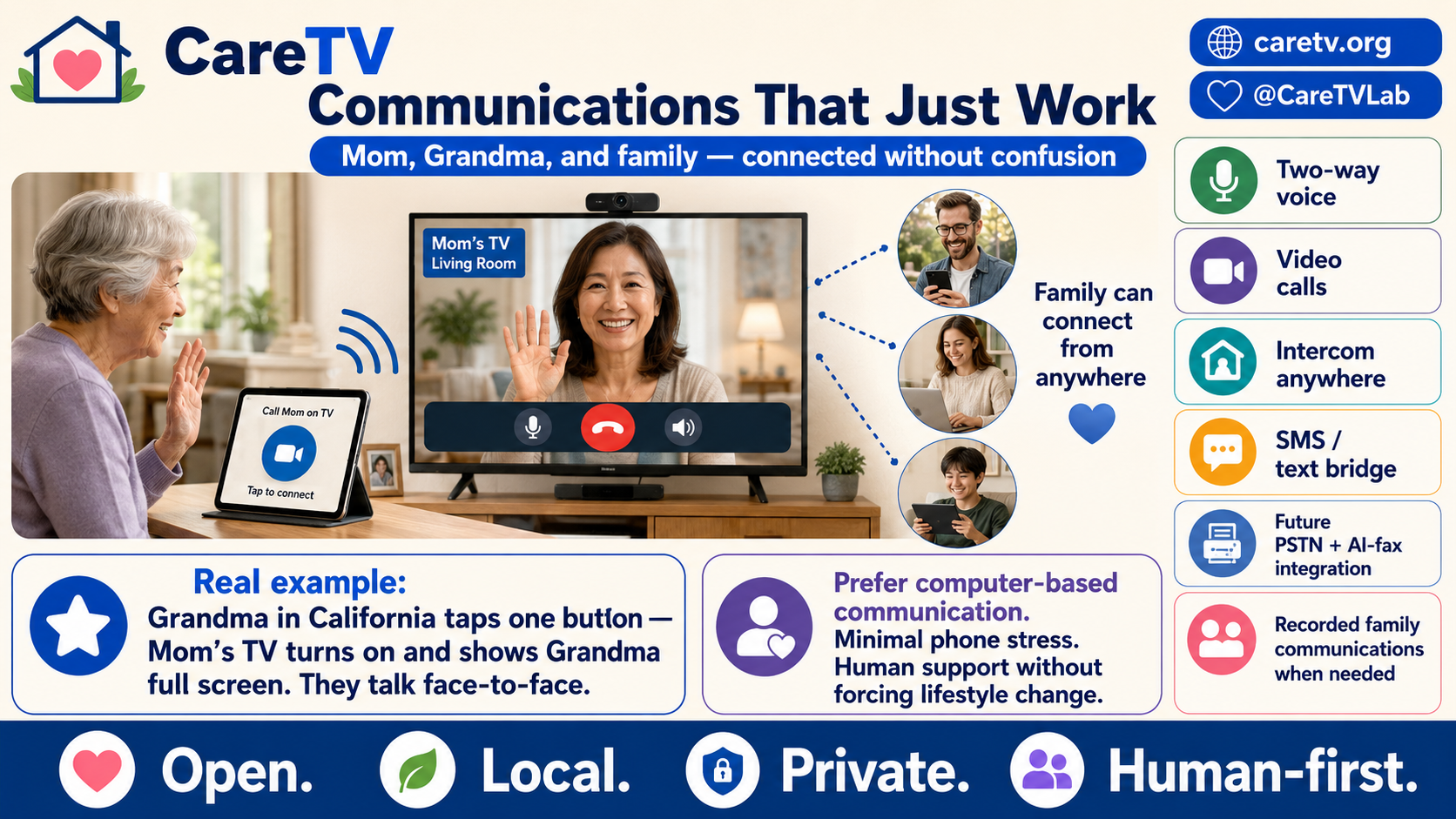
CareTV treats browser communication, WebRTC, SIP, PSTN, SMS/MMS and programmable fax as adapters around a single communications layer. Direct browser-to-browser media should be used when practical, with signaling and STUN/TURN helpers used only where needed. Traditional telephone and fax networks remain important because healthcare, government and legacy institutions still depend on them.
Computer-mediated communication is also an accessibility requirement. Chat, email, web forms, asynchronous written escalation and AI-assisted message drafting can allow people to interact with institutions without forcing stressful telephone conversations. Where external systems offer no useful API, a local Windows/browser automation agent can bridge the gap using DOM automation, accessibility APIs, deterministic UI state maps, screen recognition and explicit verification.
For QR-assisted authentication, the QR code should ordinarily carry a short-lived signed token or URL rather than a durable secret. SMS or trusted-device confirmation can provide an additional factor where appropriate.
6. Recording, indexing and memory assistance
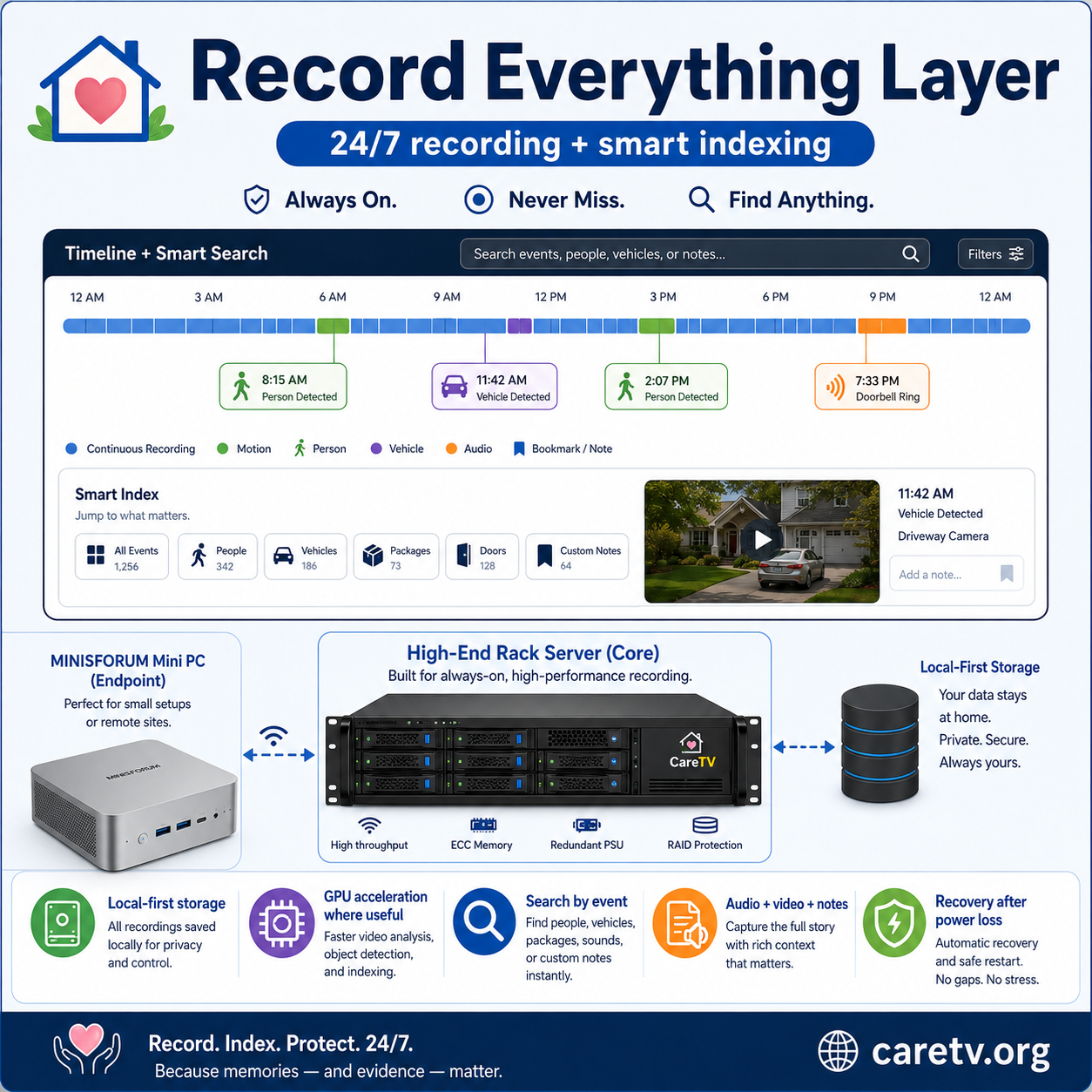
High-capability installations can continuously preserve authorized camera streams, intercom audio/video, voice commands and transcripts, system events, television/browser-control events and selected screen states. The storage model should use short timestamped segments plus metadata rather than enormous monolithic recordings.
Metadata can include source, start/end time, participants, PTZ preset, motion/person events, transcript, bookmarks, retention class, integrity hash and access history. This enables natural queries such as “show the front door from twenty minutes ago” without requiring a human to scrub through hours of video.
Recording must remain consent- and jurisdiction-aware. Preserved originals, reliable timestamps, hashes and access logs can strengthen evidentiary integrity, but CareTV should not promise that a recording is automatically admissible in a particular legal proceeding.
7. Privacy, autonomy and civil liberties
CareTV deliberately minimizes unnecessary centralized observation points. Raw household video should not leave the home merely because a vendor's business model expects it to. Local archives should remain under household control where practical, remote access should be revocable, metadata should be minimized and sensitive data should be encrypted.
This is intentionally administration-neutral and vendor-neutral. Governments change, companies change, ownership changes and policies change. Infrastructure for vulnerable people should remain usable across those changes. Open standards, local control, user-controlled identity and direct encrypted communication are resilience mechanisms as much as privacy mechanisms.
8. One capability-adaptive platform
Dementia clock, simple media, dynamic camera grid, basic WAN family communication, notes and memory assistance on ordinary devices.
Multiple cameras, PTZ, simple HID remote, local recording and caregiver controls.
Rack server, GPUs, large local storage, 100GbE, Thunderbolt 5, 24/7 indexing, advanced camera work and 8K.
Multi-room/building deployment, distributed compute, redundancy, large storage and optionally self-hosted signaling/relay infrastructure.
Hardware acceleration should be used aggressively where available—decode, encode, scaling, compositing, WebGPU/WebCodecs, NVENC/NVDEC/CUDA-class work and AI inference—while preserving software/CPU fallbacks wherever practical.
9. Two-home broadband accessibility case
The initial WAN family deployment is not hypothetical. It can span two Comcast-served family residences associated with the same customer relationship: the CareTV development/reference home and the home of a 102-year-old family member whose mobility is declining. Each location remains technically distinct, but the two-home relationship creates a concrete accessibility and broadband-engineering use case.
Upstream capacity matters because a home that records locally and communicates directly with another home must transmit its own media. In conventional consumer broadband design, downstream capacity has historically dominated product messaging. Local-first AI/video systems invert part of that assumption. Predictable upstream bandwidth can determine whether assistive workloads remain in privately controlled homes or are pushed into centralized clouds simply because the access network is asymmetric.
This is why Comcast Accessibility, network engineering and product management may reasonably view CareTV as more than a speed-tier request: it is a working model of homes becoming active compute, communications and caregiving nodes.
10. High-end reference laboratory
| Component | Role |
|---|---|
| MINISFORUM X1-255 — B0F8GPGMCY | Room endpoint prototype |
| Jabra Speak2 75 SE — B0DTCMS2K6 | Room microphone/speaker interface |
| OBSBOT Tail 2 PTZR NDI — B0GFWFTH53 | High-quality PTZ research |
| EmpireTech IPC-Color4K-X-S2 — B099RBDCCG | Wired low-light exterior IP camera |
| FLIRC USB — B01NBRBWS6 | Remote/HID bridge |
| Flipper remote — B0CR5S1BCN | Large-button physical interface |
| Elgato Cam Link 4K — B07K3FN5MR | Low-latency HDMI digitization |
| Intel Core Ultra 9 285K — B0DFKC99VL | Reference server compute |
| ASUS ProArt Z890-CREATOR WIFI — B0DGW9S82G | GPU/100GbE expansion platform |
| SilverStone RM44 4U — B0BFC8FZ8B | Serviceable rack chassis |
| LinksTek CX516A / ConnectX-5 Ex class — B0FTXR2GDB | Dual-port QSFP28 100GbE research link |
11. Reliability and recoverability
A serious assistive system must define failure behavior. The reference 24/7 educational service is intended to recover from predictable power, network, process and OS interruptions through UPS monitoring, automatic power restoration, service supervision, local fallback assets, health endpoints and event logging.
Acceptance testing should include controlled network loss, encoder/process termination, Windows restart, delayed network readiness, service initialization failures and safe UPS shutdown/recovery. “Runs indefinitely without routine human intervention” is an engineering requirement to test, not a marketing phrase to assume.
12. Distributed home computing as public infrastructure
CareTV is pro-AI and pro-computing. It challenges only the assumption that every useful AI, media and communications workload should automatically be centralized. Local camera ingest, PTZ control, speech fallback, media indexing, local inference, household archives and direct family communication often have strong reasons to remain near the people using them.
The environmental benefit is an engineering hypothesis that must be measured. Home hardware can be inefficient, while hyperscale facilities can be highly efficient per unit of compute. The appropriate research question is therefore empirical: which workloads reduce total bandwidth, recurring cost, privacy exposure, latency and energy/water impacts when moved to the edge, and which do not?
13. Status and roadmap
| Status | Work |
|---|---|
| WORKING NOW / PUBLIC BUILD | Dated browser experiments including dementia-clock work and public CareTV development artifacts. |
| ACTIVE PROTOTYPE | Dynamic camera/grid work, PTZ experimentation, room hardware, rack server/network reference architecture and simple remote-control bridges. |
| NEXT IMPLEMENTATION | Voice → normalized intent → deterministic TV/camera control; WAN family communications; indexed continuous recording; telecom/fax adapters. |
| LONG-TERM RESEARCH | A more appliance-like open CareTV operating environment, broad internationalization and institutional deployment without sacrificing open APIs. |
14. Ten explanatory figures
The following ten figures are independent 16:9 assets. Each lives in its own named folder so the figure can be referenced independently from either the canonical CareTV publication or the immutable 8K.art daily-build archive.
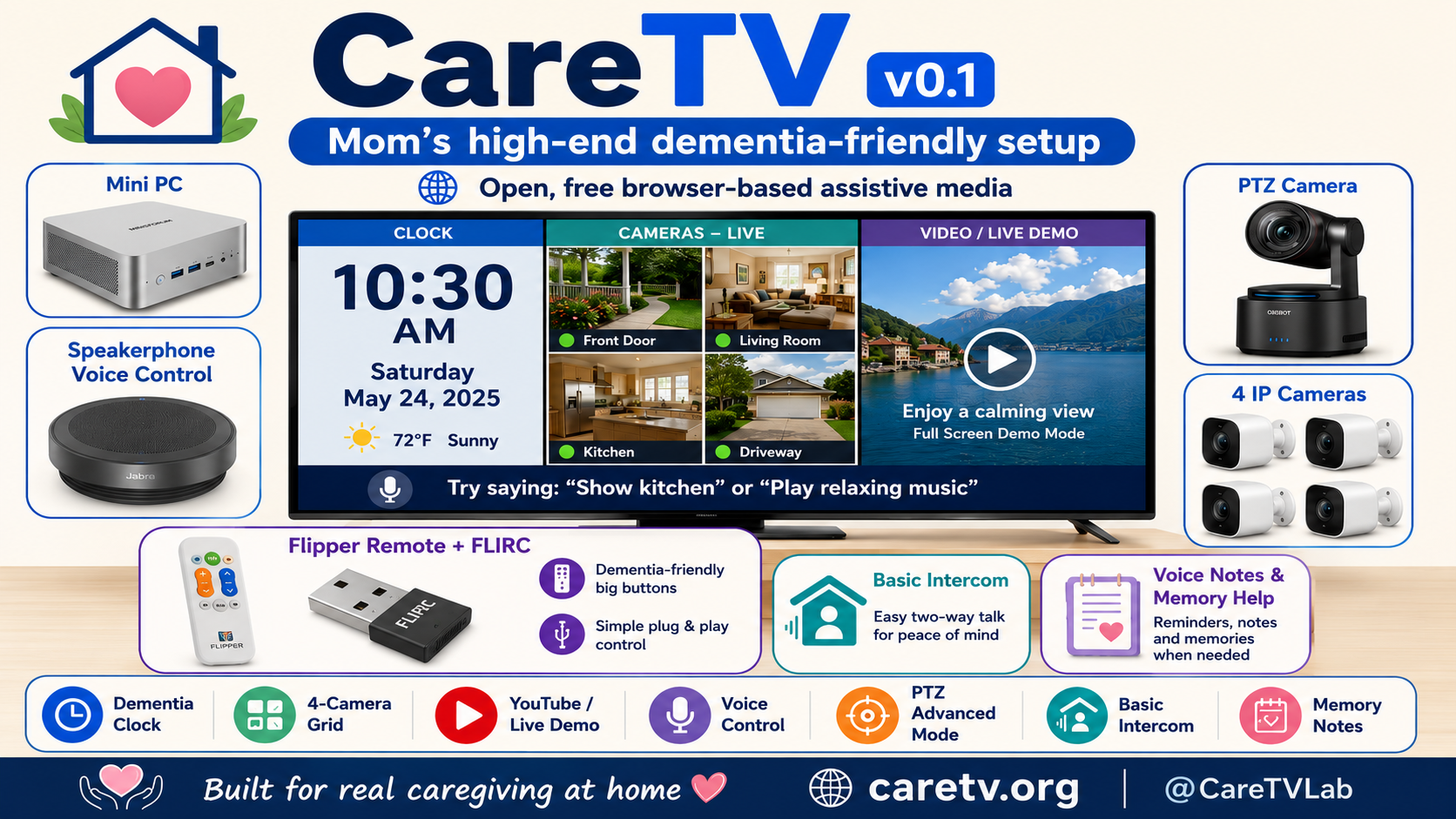
CareTV image: https://caretv.org/briefing/figures/01-caretv-dementia-friendly-home-setup/01-caretv-dementia-friendly-home-setup.png
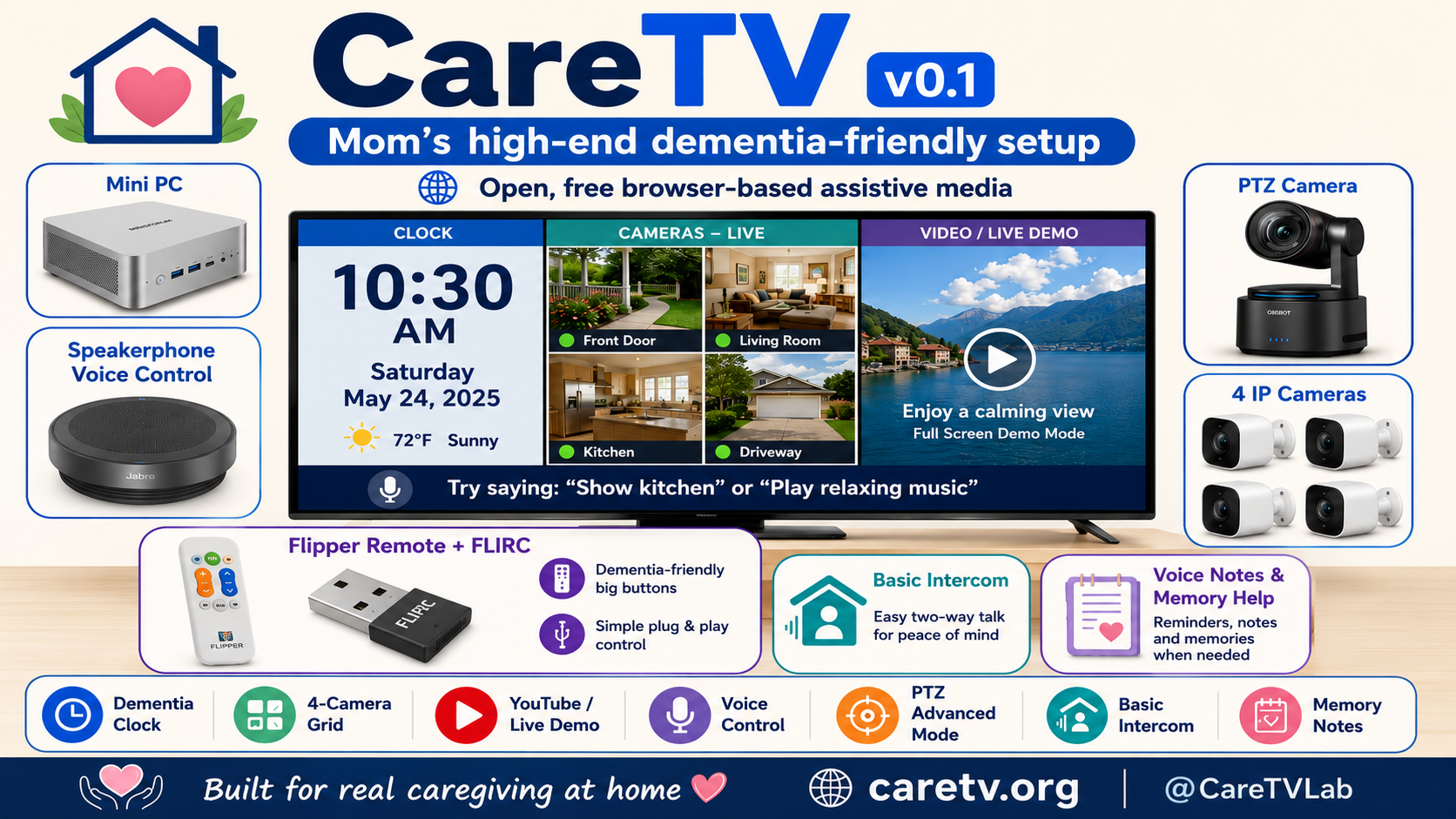
8K.art archive folder: https://8k.art/beta/_daily-builds/2026-08-17/caretv-professional-briefing-2026-08-17-v001/figures/01-caretv-dementia-friendly-home-setup/
8K.art image: https://8k.art/beta/_daily-builds/2026-08-17/caretv-professional-briefing-2026-08-17-v001/figures/01-caretv-dementia-friendly-home-setup/01-caretv-dementia-friendly-home-setup.png
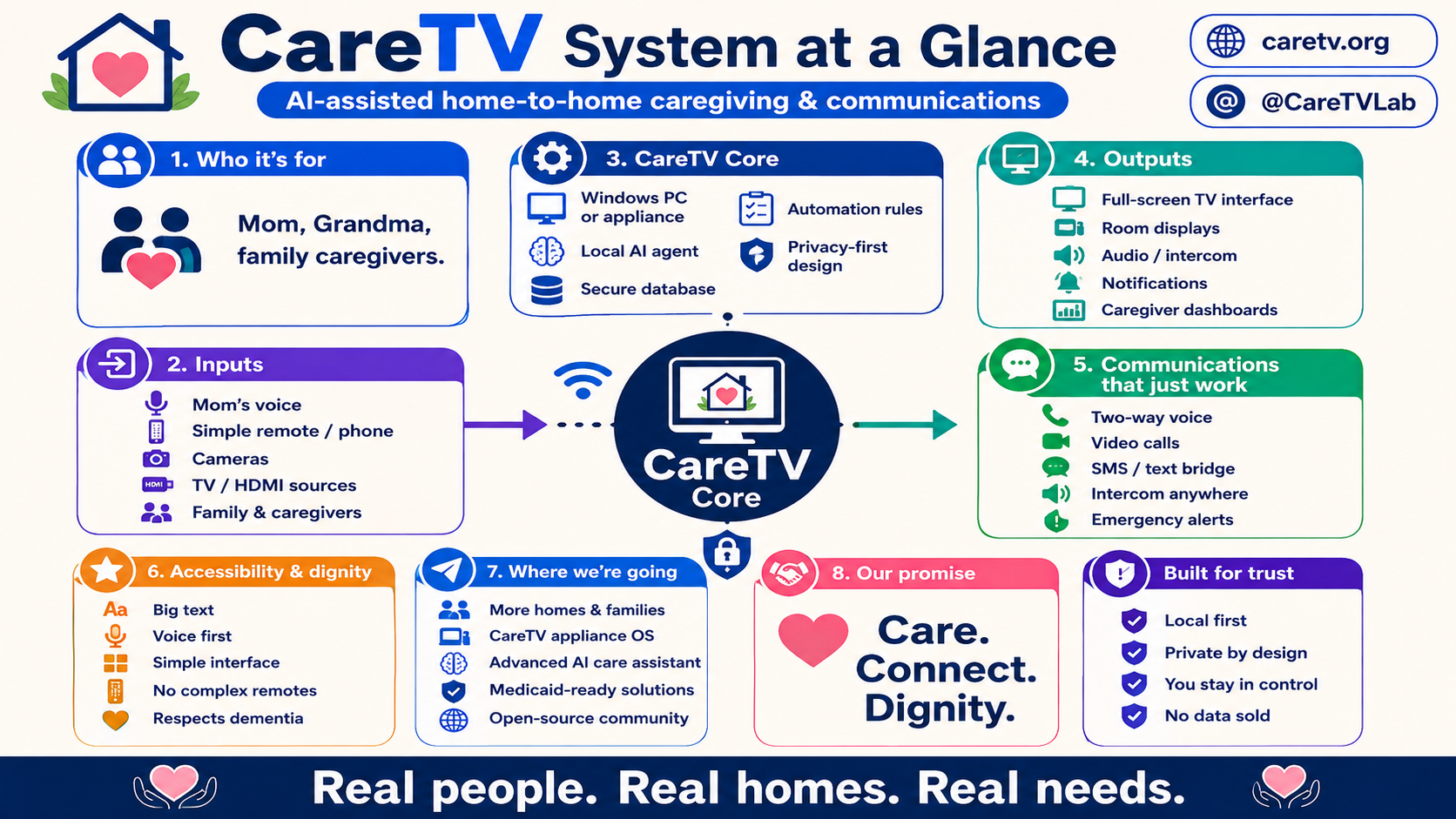
CareTV image: https://caretv.org/briefing/figures/02-caretv-system-at-a-glance/02-caretv-system-at-a-glance.png
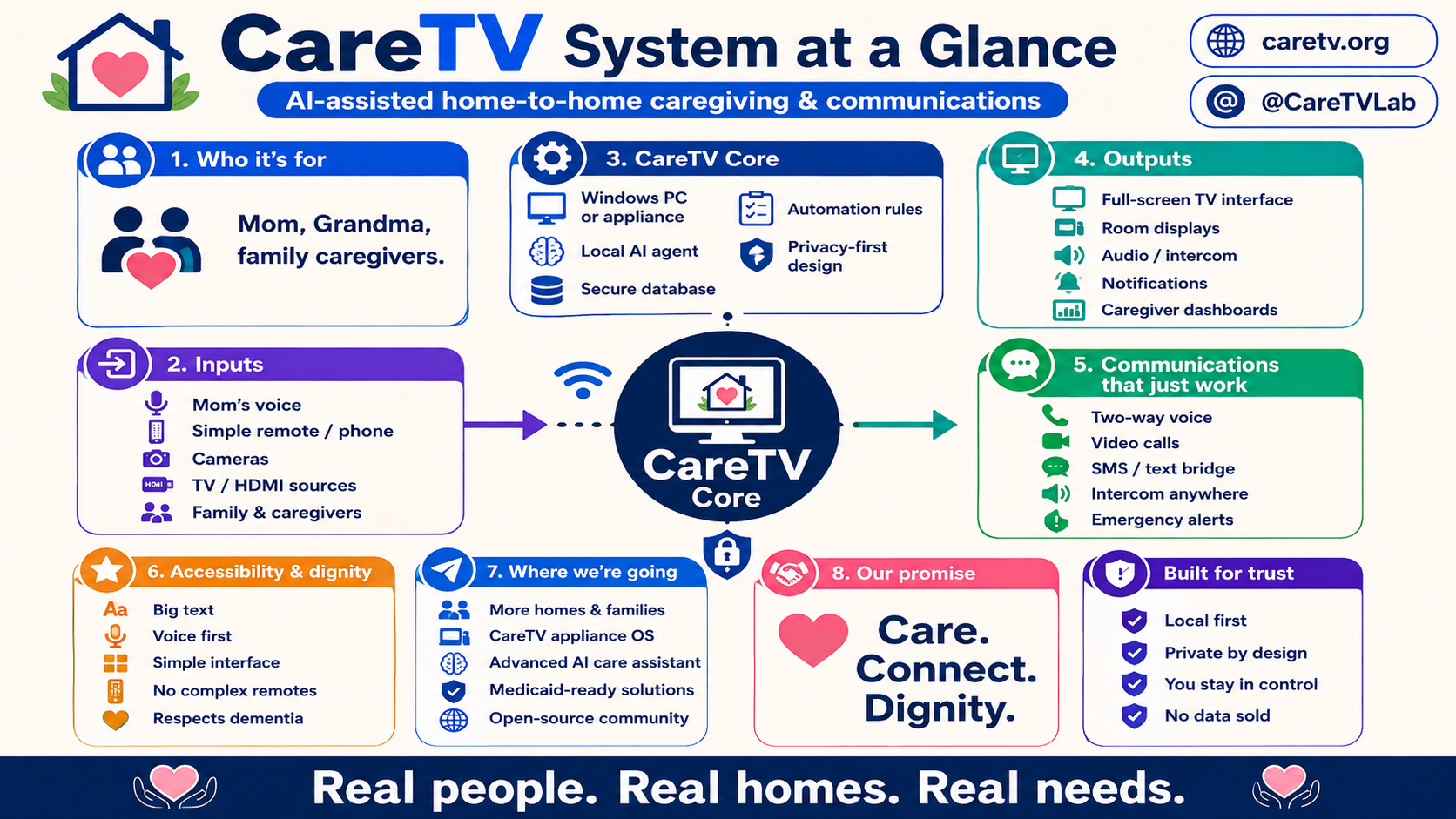
8K.art archive folder: https://8k.art/beta/_daily-builds/2026-08-17/caretv-professional-briefing-2026-08-17-v001/figures/02-caretv-system-at-a-glance/
8K.art image: https://8k.art/beta/_daily-builds/2026-08-17/caretv-professional-briefing-2026-08-17-v001/figures/02-caretv-system-at-a-glance/02-caretv-system-at-a-glance.png
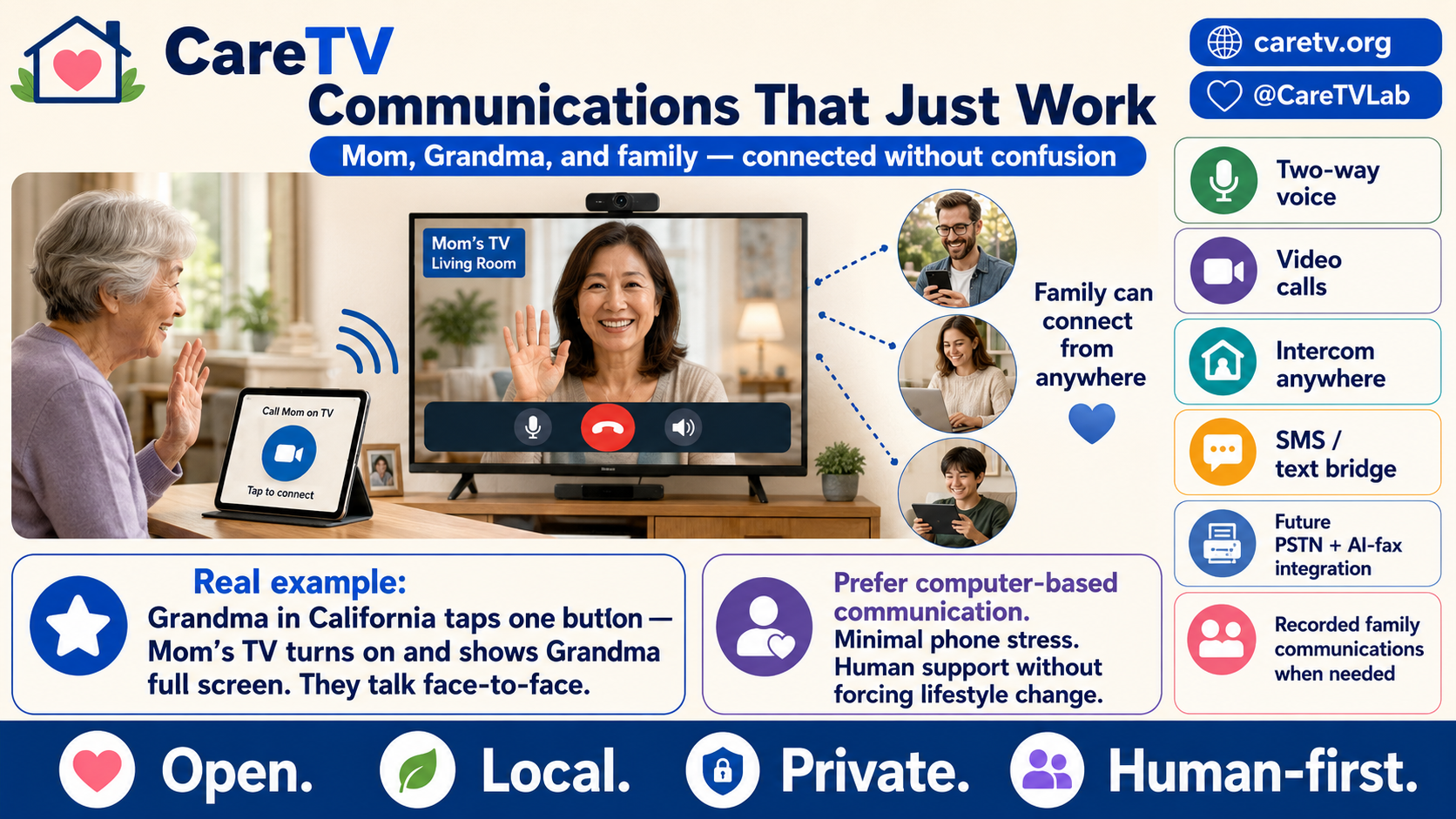
CareTV image: https://caretv.org/briefing/figures/03-caretv-communications-that-just-work/03-caretv-communications-that-just-work.png
8K.art archive folder: https://8k.art/beta/_daily-builds/2026-08-17/caretv-professional-briefing-2026-08-17-v001/figures/03-caretv-communications-that-just-work/
8K.art image: https://8k.art/beta/_daily-builds/2026-08-17/caretv-professional-briefing-2026-08-17-v001/figures/03-caretv-communications-that-just-work/03-caretv-communications-that-just-work.png
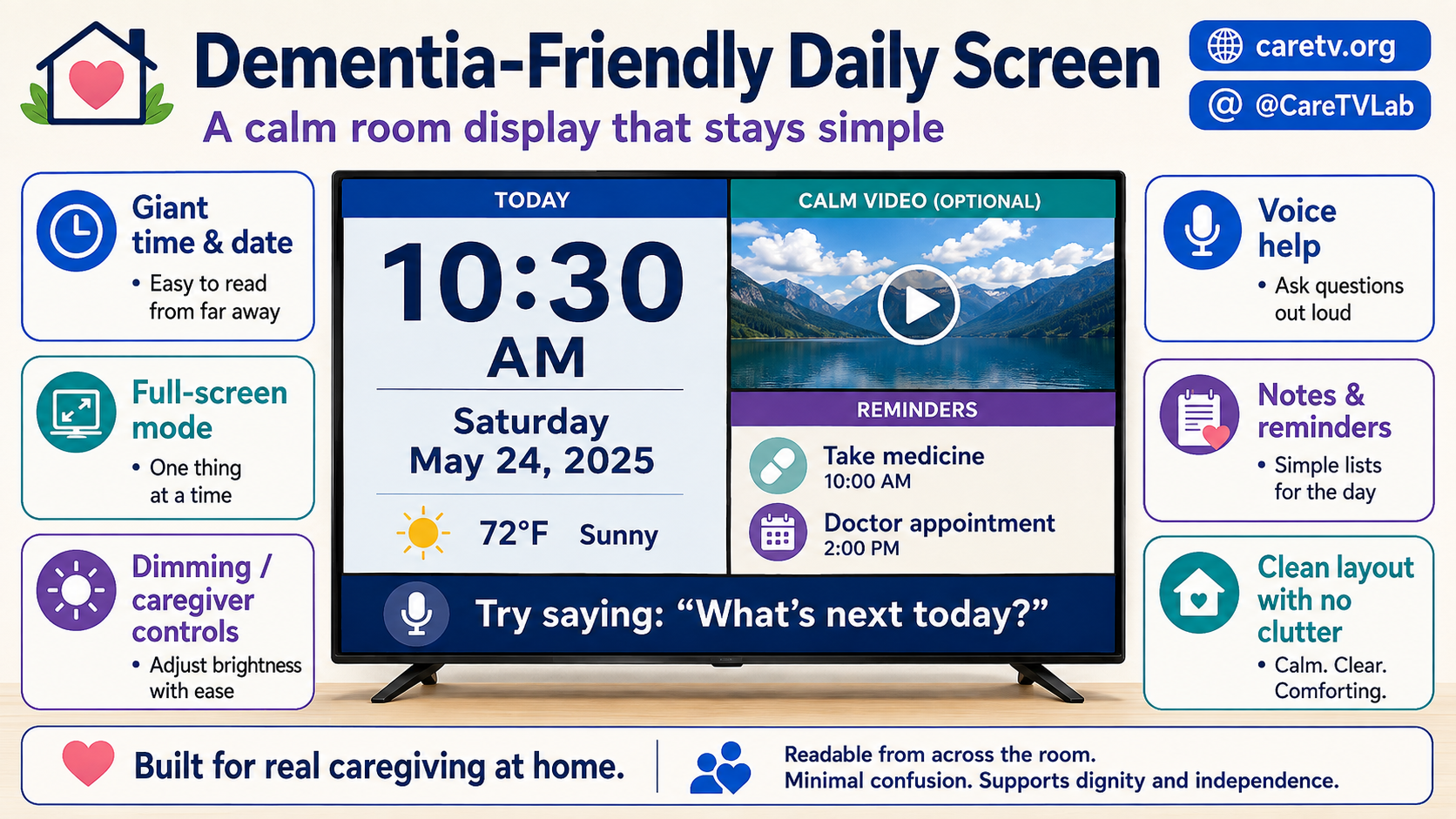
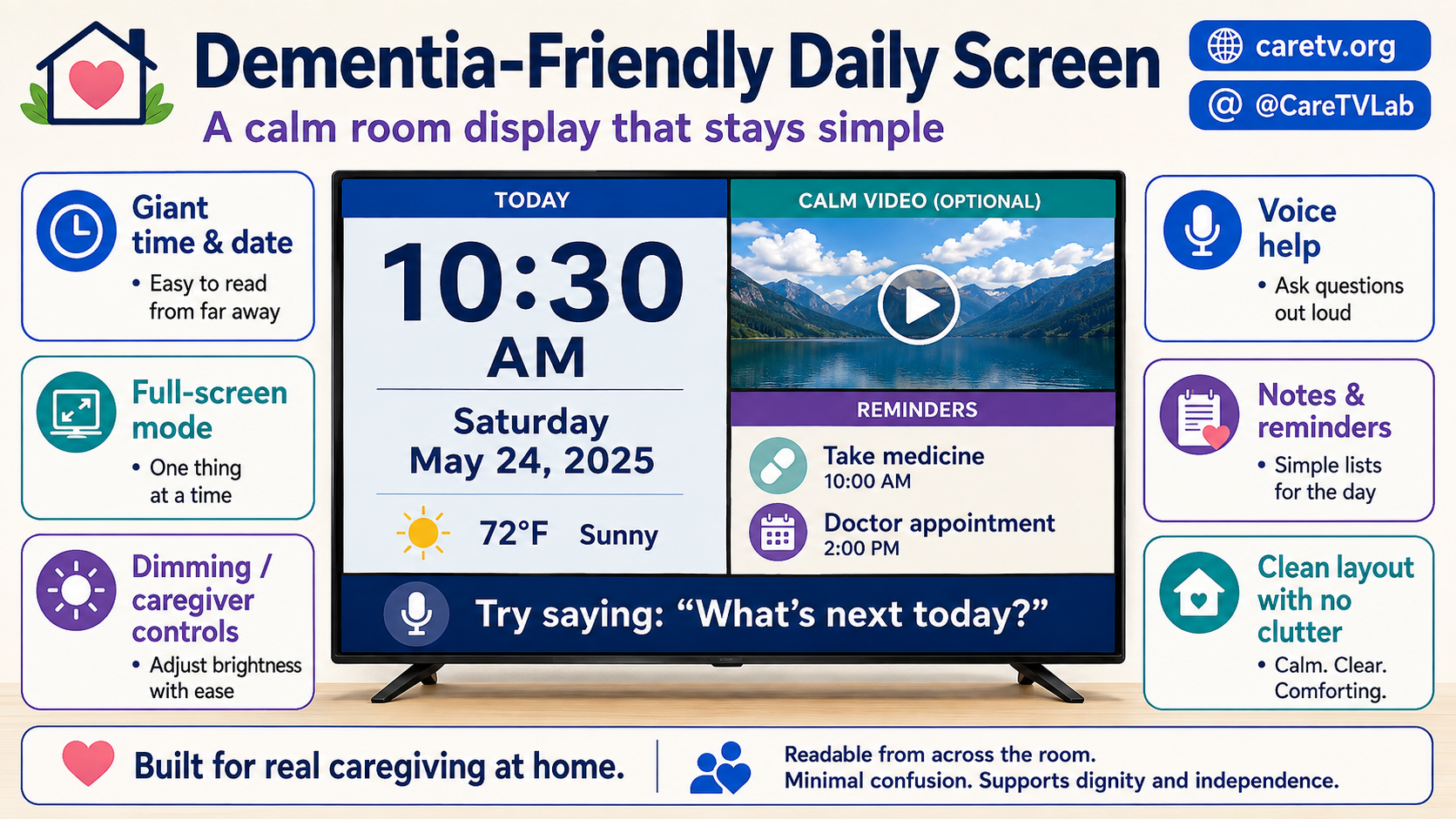
CareTV image: https://caretv.org/briefing/figures/04-caretv-dementia-friendly-daily-screen/04-caretv-dementia-friendly-daily-screen.png
8K.art archive folder: https://8k.art/beta/_daily-builds/2026-08-17/caretv-professional-briefing-2026-08-17-v001/figures/04-caretv-dementia-friendly-daily-screen/
8K.art image: https://8k.art/beta/_daily-builds/2026-08-17/caretv-professional-briefing-2026-08-17-v001/figures/04-caretv-dementia-friendly-daily-screen/04-caretv-dementia-friendly-daily-screen.png
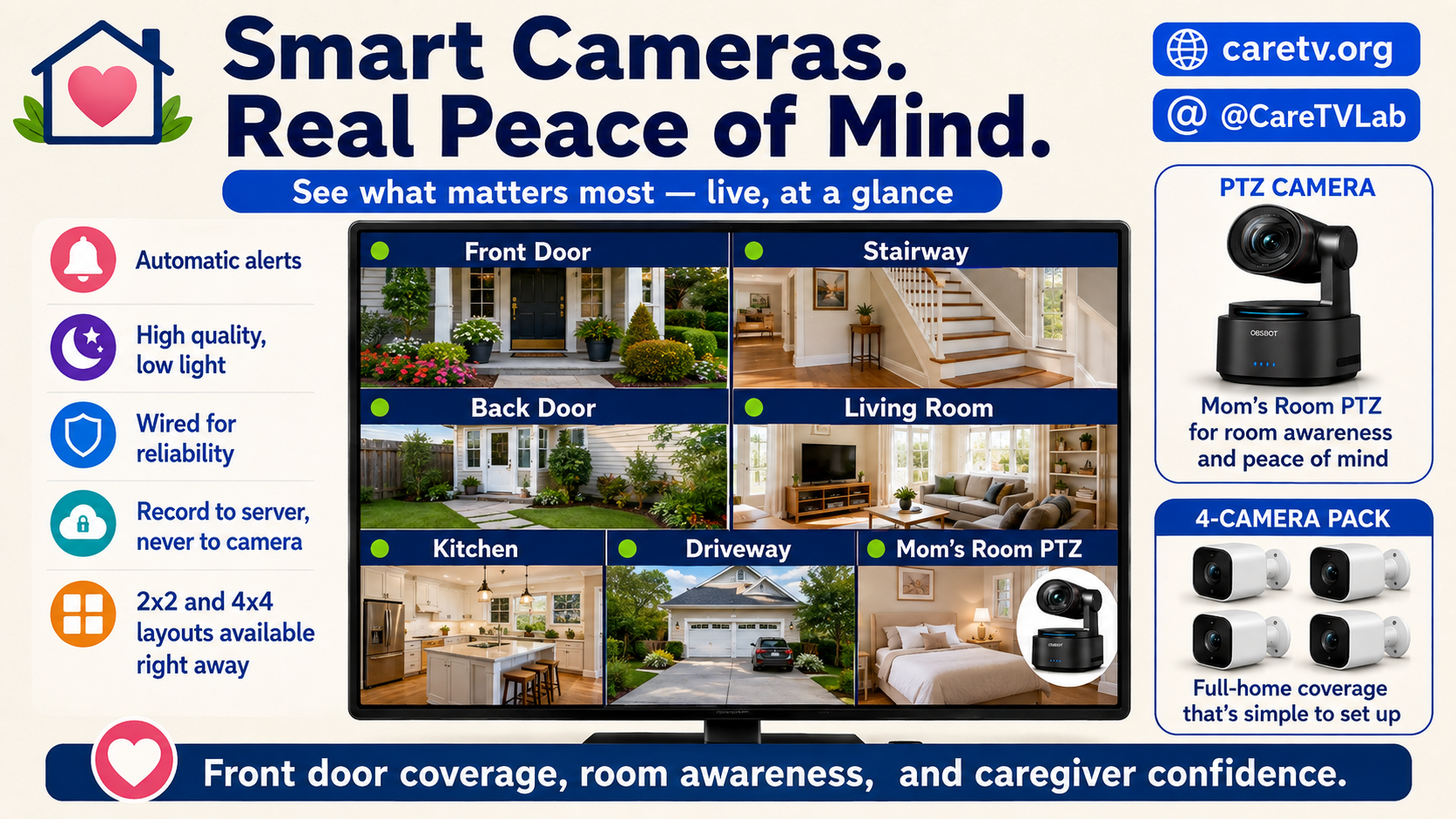
CareTV image: https://caretv.org/briefing/figures/05-caretv-smart-cameras-peace-of-mind/05-caretv-smart-cameras-peace-of-mind.png
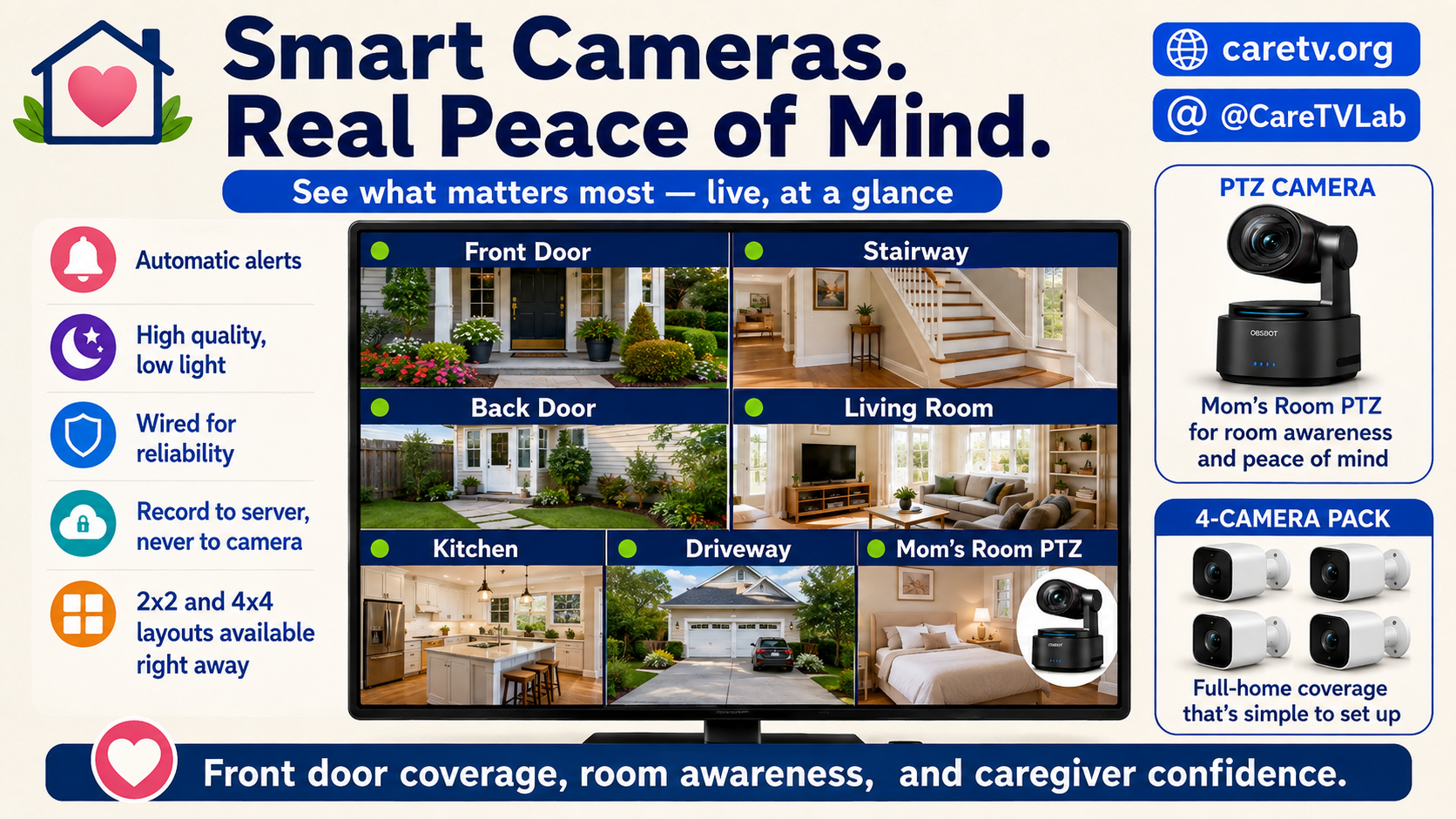
8K.art archive folder: https://8k.art/beta/_daily-builds/2026-08-17/caretv-professional-briefing-2026-08-17-v001/figures/05-caretv-smart-cameras-peace-of-mind/
8K.art image: https://8k.art/beta/_daily-builds/2026-08-17/caretv-professional-briefing-2026-08-17-v001/figures/05-caretv-smart-cameras-peace-of-mind/05-caretv-smart-cameras-peace-of-mind.png
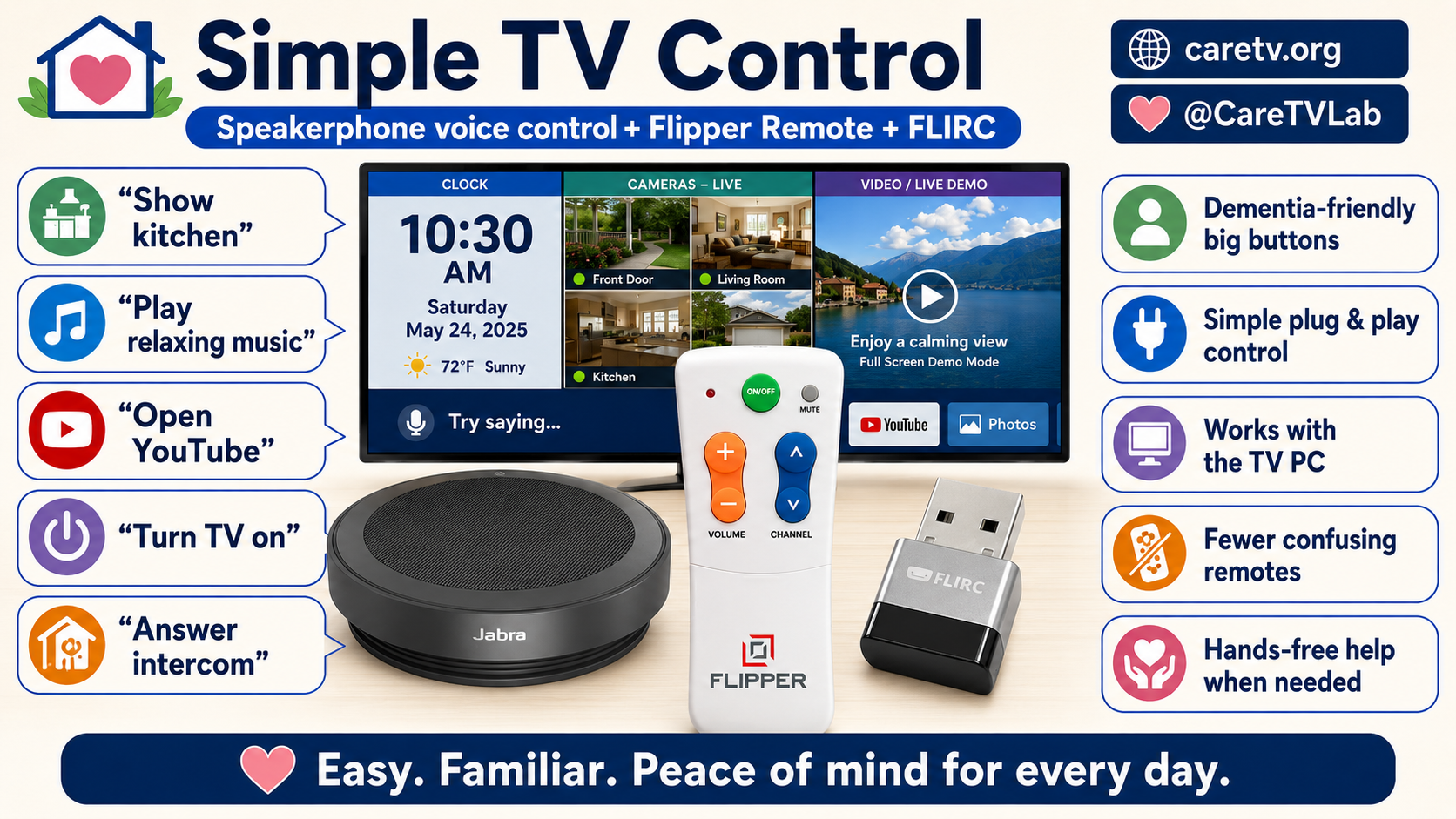
CareTV image: https://caretv.org/briefing/figures/06-caretv-simple-tv-control/06-caretv-simple-tv-control.png
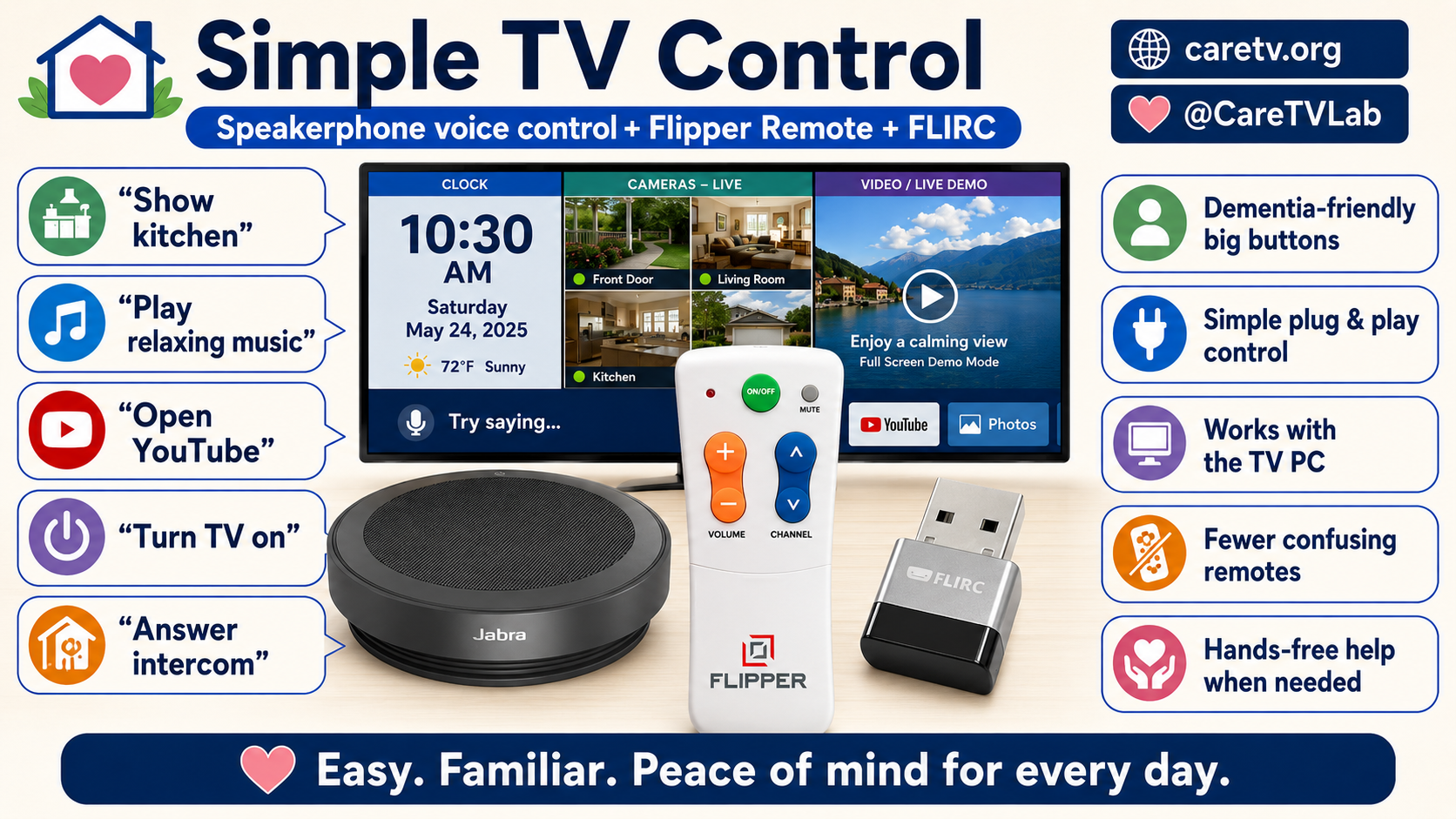
8K.art archive folder: https://8k.art/beta/_daily-builds/2026-08-17/caretv-professional-briefing-2026-08-17-v001/figures/06-caretv-simple-tv-control/
8K.art image: https://8k.art/beta/_daily-builds/2026-08-17/caretv-professional-briefing-2026-08-17-v001/figures/06-caretv-simple-tv-control/06-caretv-simple-tv-control.png
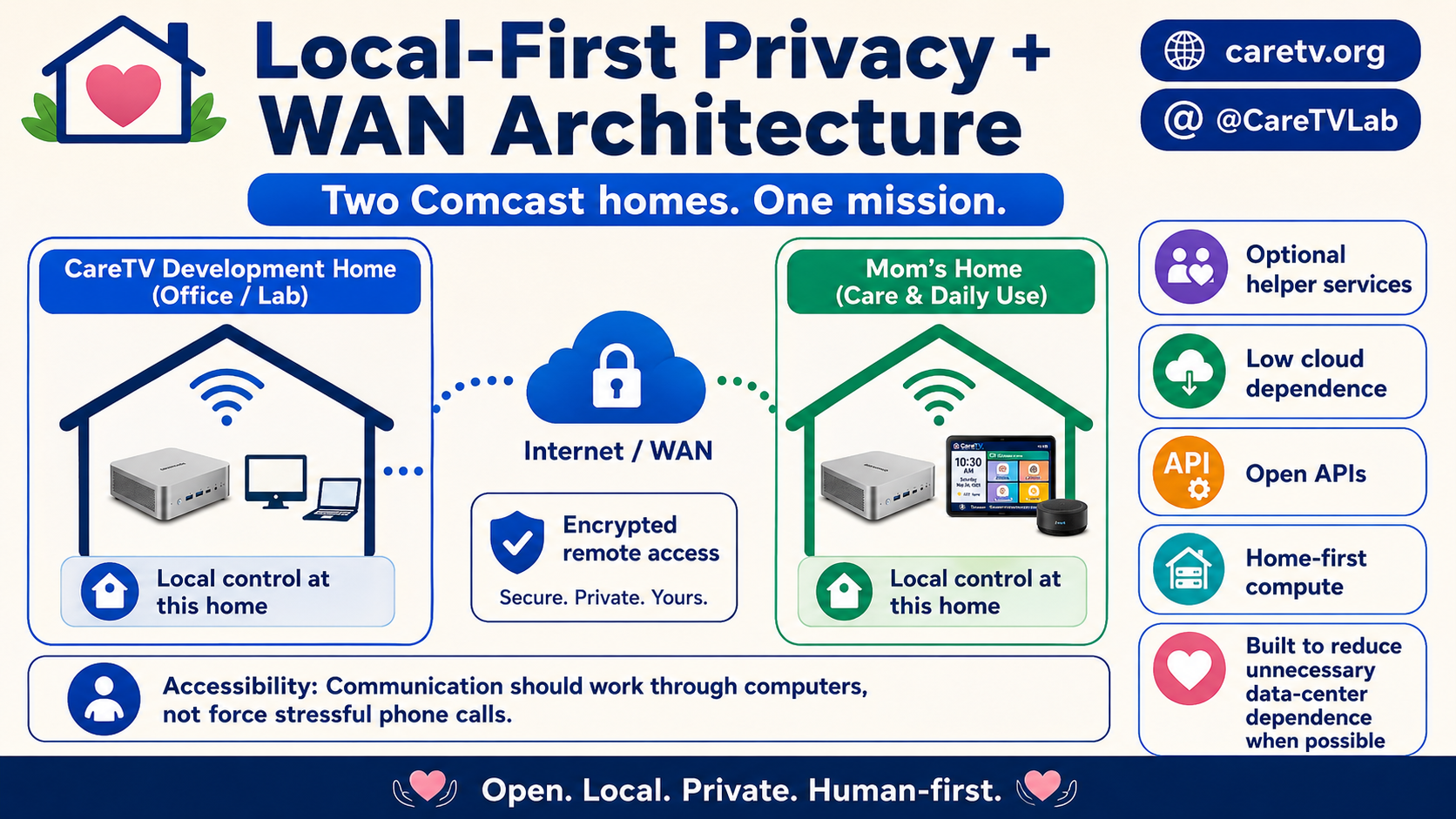
CareTV image: https://caretv.org/briefing/figures/07-caretv-local-first-privacy-wan/07-caretv-local-first-privacy-wan.png
8K.art archive folder: https://8k.art/beta/_daily-builds/2026-08-17/caretv-professional-briefing-2026-08-17-v001/figures/07-caretv-local-first-privacy-wan/
8K.art image: https://8k.art/beta/_daily-builds/2026-08-17/caretv-professional-briefing-2026-08-17-v001/figures/07-caretv-local-first-privacy-wan/07-caretv-local-first-privacy-wan.png
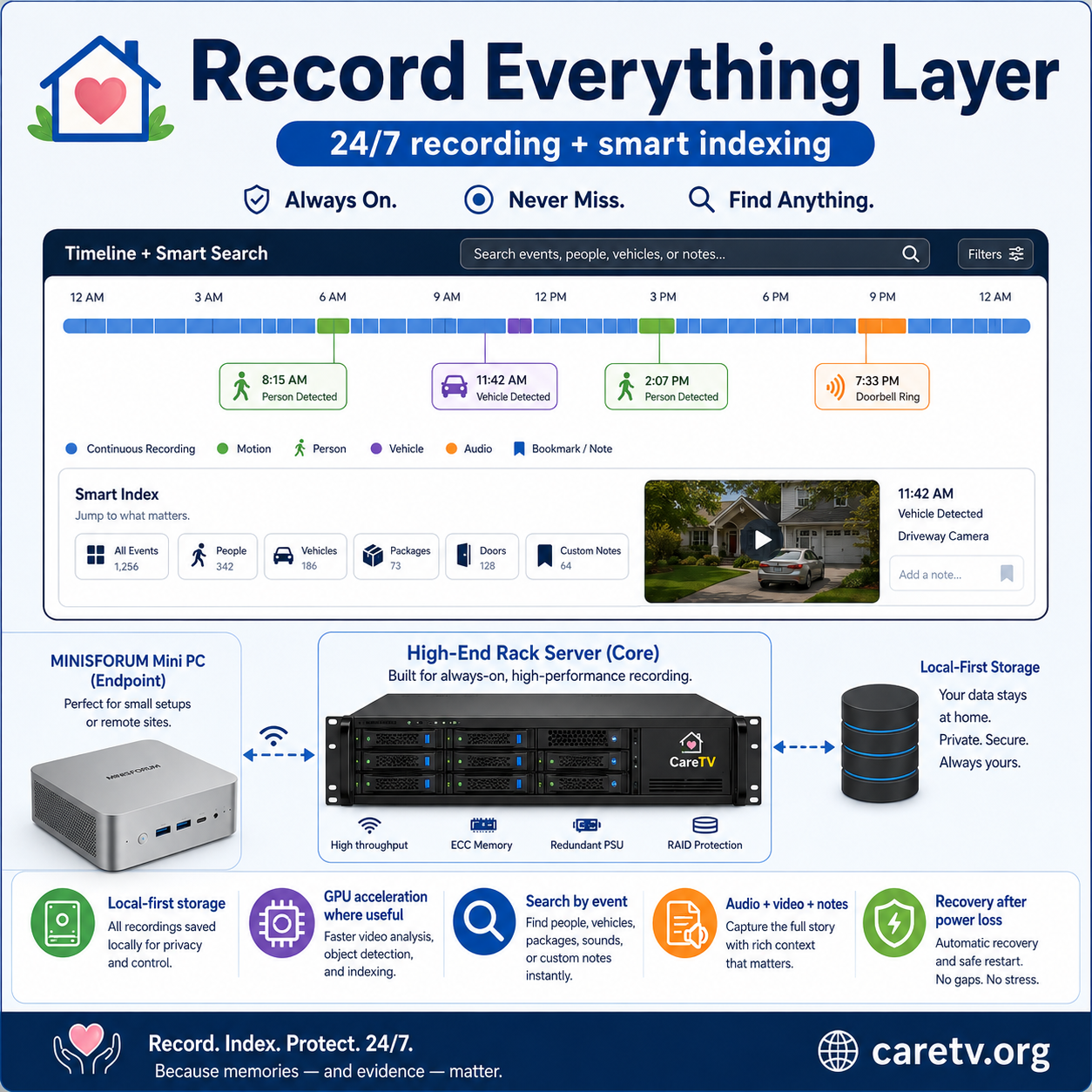
CareTV image: https://caretv.org/briefing/figures/08-caretv-record-everything-layer/08-caretv-record-everything-layer.png
8K.art archive folder: https://8k.art/beta/_daily-builds/2026-08-17/caretv-professional-briefing-2026-08-17-v001/figures/08-caretv-record-everything-layer/
8K.art image: https://8k.art/beta/_daily-builds/2026-08-17/caretv-professional-briefing-2026-08-17-v001/figures/08-caretv-record-everything-layer/08-caretv-record-everything-layer.png
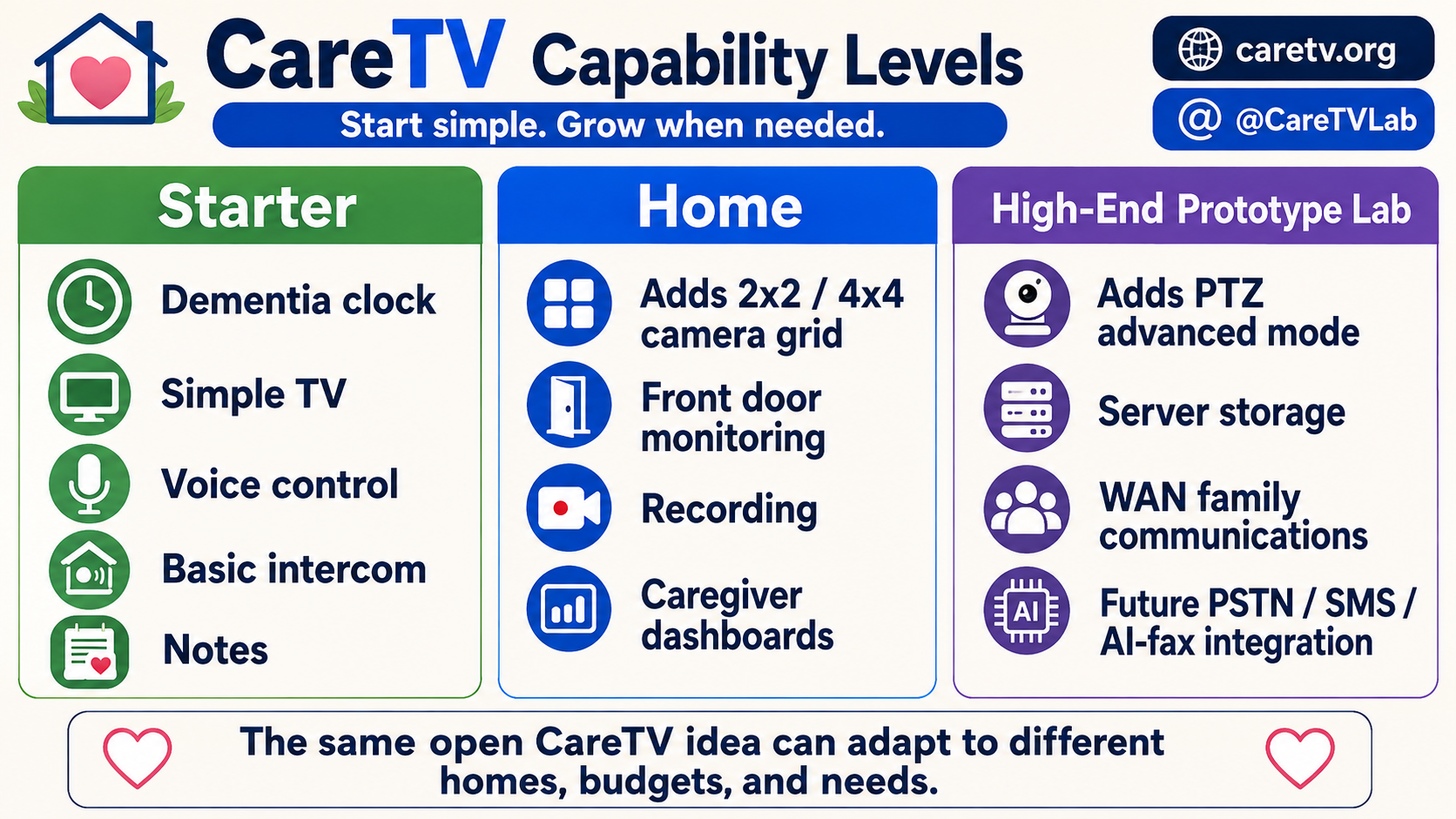
CareTV image: https://caretv.org/briefing/figures/09-caretv-capability-levels/09-caretv-capability-levels.png
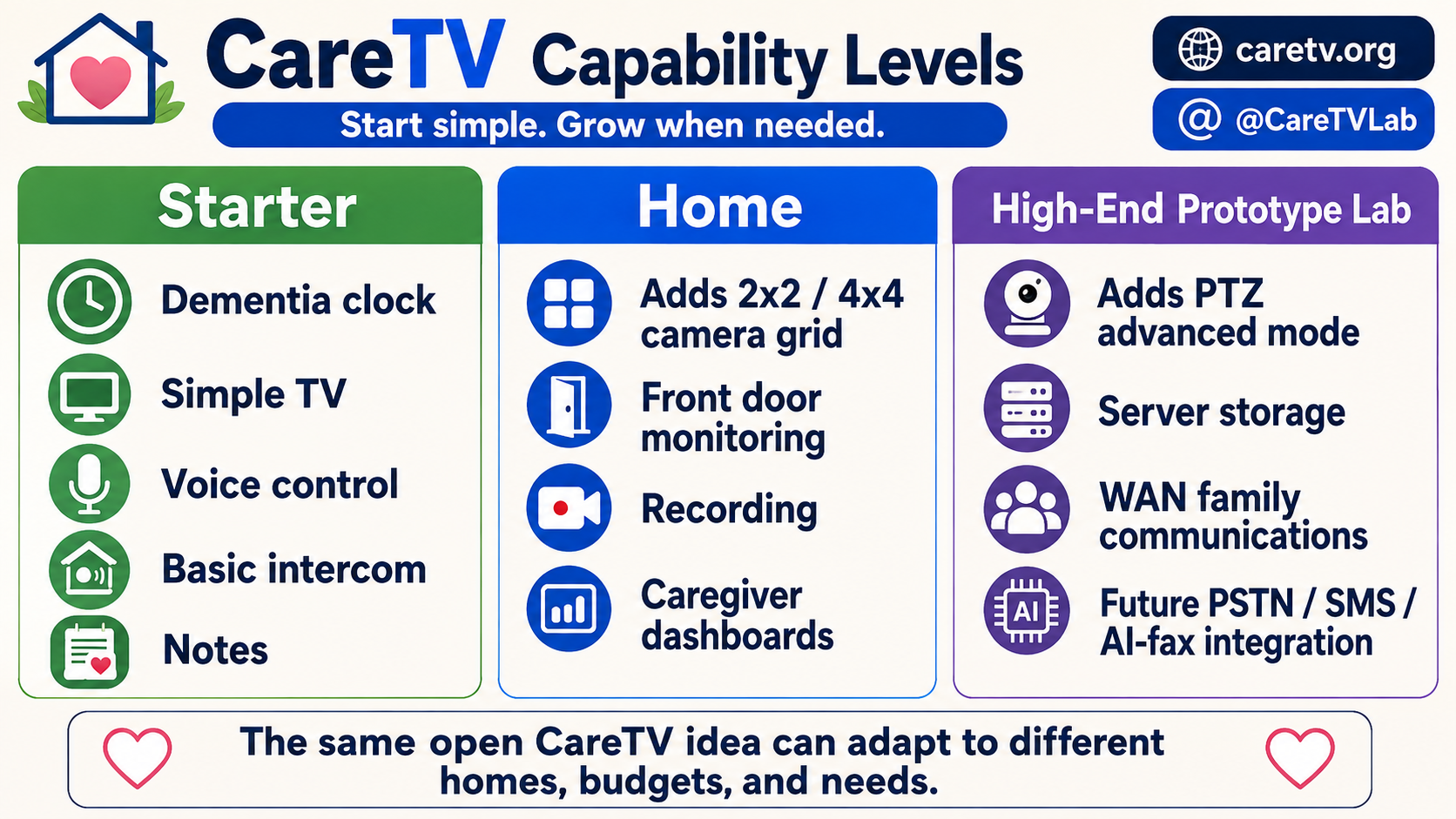
8K.art archive folder: https://8k.art/beta/_daily-builds/2026-08-17/caretv-professional-briefing-2026-08-17-v001/figures/09-caretv-capability-levels/
8K.art image: https://8k.art/beta/_daily-builds/2026-08-17/caretv-professional-briefing-2026-08-17-v001/figures/09-caretv-capability-levels/09-caretv-capability-levels.png
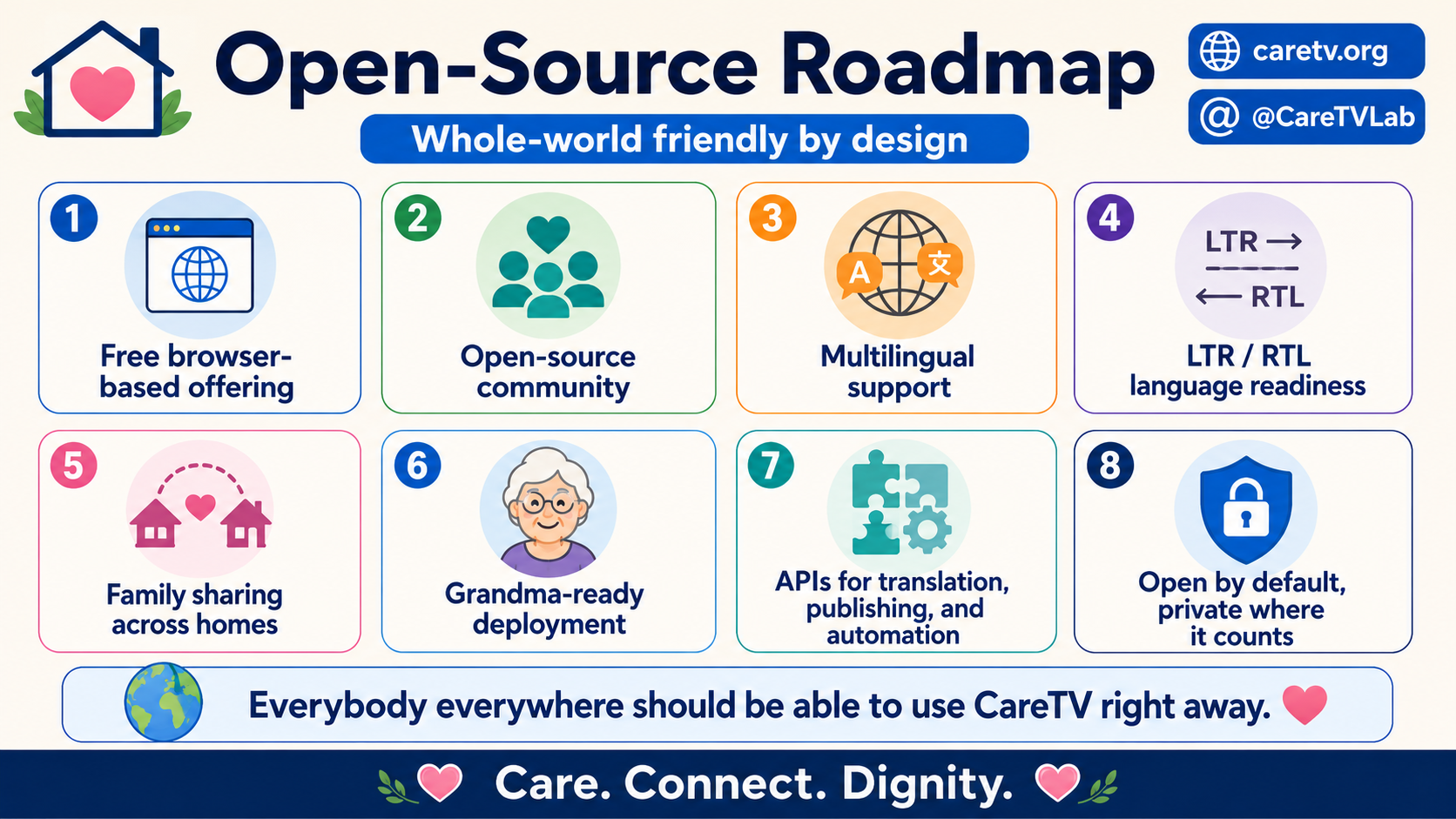
CareTV image: https://caretv.org/briefing/figures/10-caretv-open-source-roadmap/10-caretv-open-source-roadmap.png
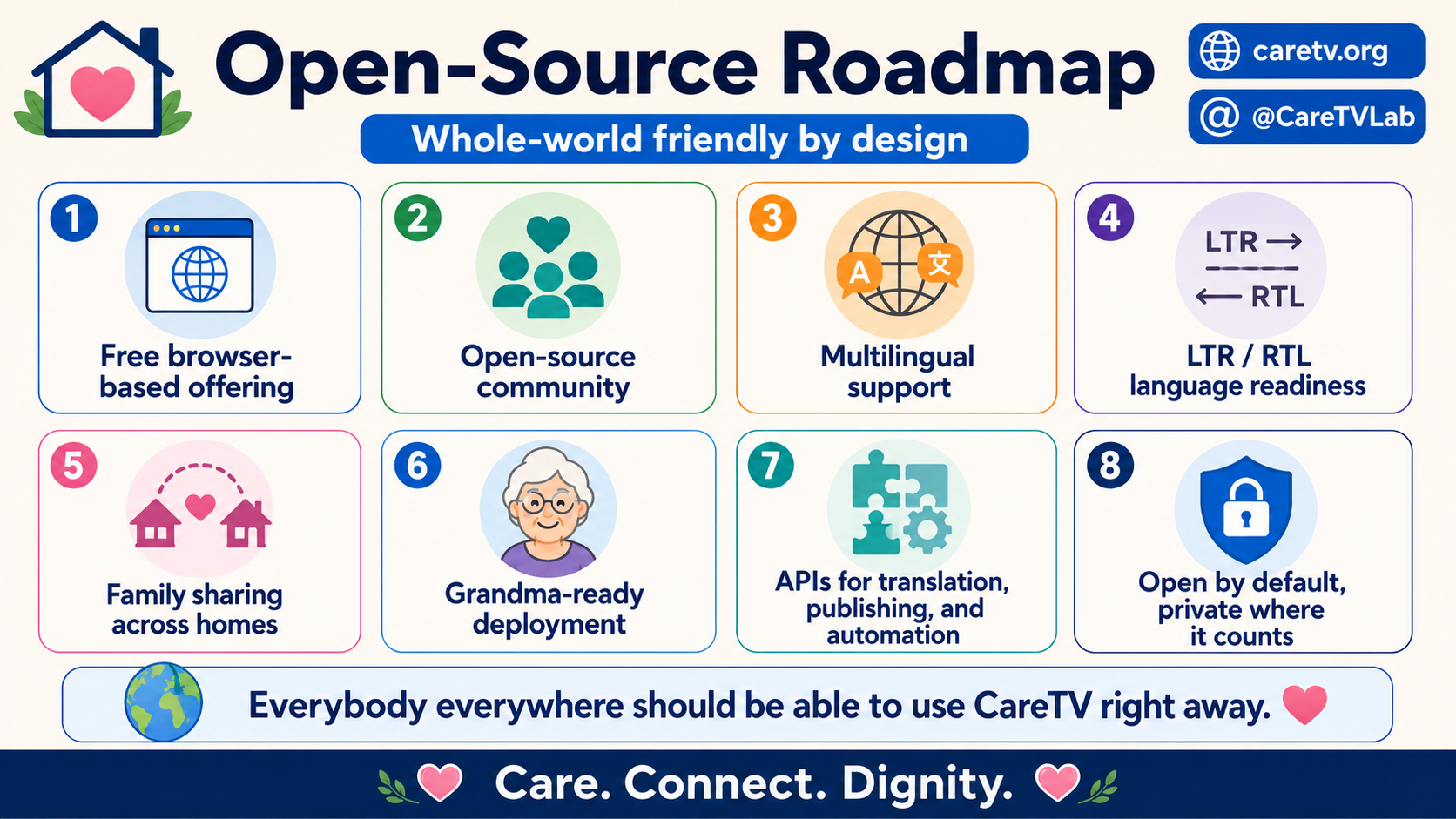
8K.art archive folder: https://8k.art/beta/_daily-builds/2026-08-17/caretv-professional-briefing-2026-08-17-v001/figures/10-caretv-open-source-roadmap/
8K.art image: https://8k.art/beta/_daily-builds/2026-08-17/caretv-professional-briefing-2026-08-17-v001/figures/10-caretv-open-source-roadmap/10-caretv-open-source-roadmap.png
15. Intended evaluators and next conversations
This briefing is intended to be useful to social workers, aging and disability services, Medicaid program staff, accessibility specialists, family caregivers, nonprofits, universities, broadband providers, local government, foundations and engineers. The immediate external case is Comcast Accessibility: review the two-home use case, current upstream limitations, accessible written-support requirements and the implications of local-first assistive computing for future residential broadband.
CareTV's public-facing institutional brand should remain professional, nonpartisan and evidence-oriented. Broader political commentary about centralized infrastructure, wealth/power concentration, surveillance and current financial/political conditions belongs in a separate companion 8K.art package so that evaluators can consider CareTV on its technical and human merits without requiring agreement on a political thesis.